No credit card required
 Thank you for your request. We will contact you shortly.
 Thank you for your request. We will contact you shortly.


What Is a Staff Duress System in Healthcare?
What Is a Staff Duress System in Healthcare?
When a healthcare worker feels threatened, every second counts. A staff duress system is the technology that bridges the gap between danger and response — and in modern hospitals, it is powered by Real-Time Location Systems (RTLS). This guide answers the most common questions about staff duress systems, how they work, and why healthcare facilities across the United States are making them a priority.
What Is a Staff Duress System?
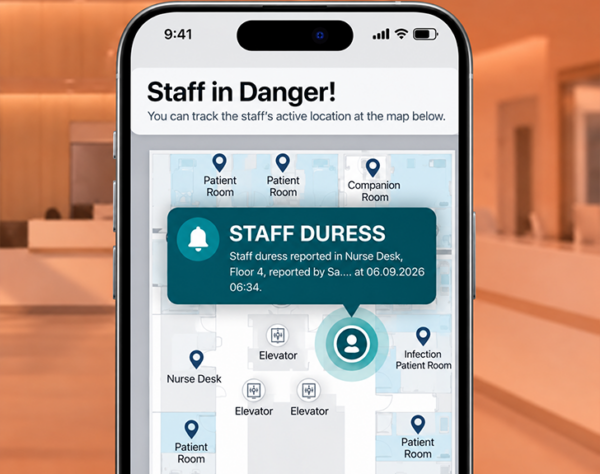
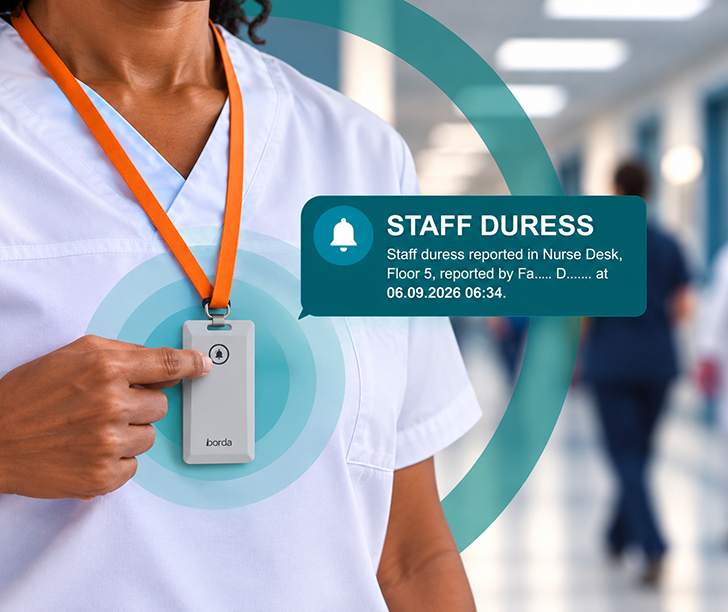
A staff duress system is a safety technology that allows hospital employees to send an immediate emergency alert when they feel threatened, unsafe, or in need of urgent assistance. When activated, the system instantly notifies security personnel with the staff member’s precise real-time location, enabling a fast and accurate response.
Modern staff duress systems are wearable, always-on, and require nothing more than a single button press to activate — even in the most stressful situations.
What Is RTLS and How Does It Work in Healthcare?
RTLS stands for Real-Time Location System. In healthcare, healthcare RTLS uses a network of wireless sensors and wearable tags to continuously track the location of staff, patients, and assets throughout a hospital facility — down to the room level.
When integrated with a staff duress system, RTLS ensures that the moment a panic alert is triggered, the exact location of the staff member is immediately transmitted to security. There is no delay, no manual reporting, and no guesswork about where the incident is occurring.
How Does a Hospital Staff Duress System Work?
A hospital staff duress system works in four steps:
Step 1 — Wearable Tag: Each staff member wears a lightweight RTLS-enabled Staff Safety Tag clipped to their collar, badge lanyard, or uniform. The tag tracks their location continuously in the background — with a 5-year battery life ensuring uninterrupted coverage.
Step 2 — Panic Alert Activation: When a staff member feels threatened, they press the panic button on their tag. The alert fires instantly.
Step 3 — White Code Alarm: A white code alarm is activated within the hospital’s security system, and the staff member’s precise location is transmitted to security personnel in real time.
Step 4 — Immediate Response: Security teams respond directly to the location with no lag, no manual routing, and no delay. The system continues to stream the staff member’s live location until the incident is resolved.
What Is a White Code Alarm in a Hospital?
A white code alarm is the emergency signal used in hospitals to indicate that a staff member is in danger or experiencing a violent or threatening incident. When a white code is activated through a staff duress system, it alerts security personnel to respond immediately to the location of the affected staff member.
RTLS staff duress systems automate white code activation, eliminating the need for manual reporting and ensuring that the alarm reaches the right people instantly.
Why Is Staff Duress a Growing Problem in Healthcare?
Workplace violence in healthcare is on a steady and documented rise. Nurses, physicians, technicians, and support staff regularly face aggressive patient behavior, threatening visitors, and high-pressure scenarios that can escalate without warning.
The core problem is not just the frequency of incidents — it is the response gap. In facilities without a dedicated staff duress system, staff in danger have no reliable way to call for help and ensure responders know exactly where to go. RTLS-based staff duress technology closes this gap entirely.
What Is Nurse Duress and How Can Hospitals Address It?
Nurse duress refers to the physical or psychological distress experienced by nurses during threatening or violent workplace incidents. It is one of the leading contributors to nurse burnout, turnover, and dissatisfaction in the U.S. healthcare system.
Hospitals address nurse duress by deploying wearable RTLS-enabled staff safety tags that give nurses a direct, one-touch lifeline to security — available anywhere in the facility, at any hour. When nurses feel protected, their psychological safety improves, their focus on patient care increases, and retention rates rise.
What Is the Difference Between a Panic Button and an RTLS Staff Duress System?
A traditional panic button sends an alert but provides no location data. Responders know that someone needs help — but not where they are.
An RTLS staff duress system does both simultaneously. When a staff member activates their wearable tag, the alert is sent and their precise, real-time location is immediately transmitted to security. As the situation evolves, the system continues to stream live location updates, allowing responders to follow the staff member’s exact movements across the facility.
What Features Should a Hospital Look for in a Staff Duress System?
When evaluating staff duress systems for hospitals, key features to prioritize include:
Real-time location accuracy — Room-level or sub-room precision, with multi-floor support for large hospital campuses.
One-touch activation — Simple enough to activate under extreme stress, with no complex sequences or codes required.
White code alarm integration — Automatic triggering of existing hospital alarm protocols upon alert activation.
CCTV and security system integration — Seamless connection to existing video management and access control infrastructure.
Long battery life — Staff Safety Tags with a 5-year battery life ensure continuous operation without maintenance disruption.
Compliance reporting — Complete digital records of every incident, including timestamps, location paths, and response times, to support Joint Commission and CMS requirements.
How Does RTLS Staff Duress Improve Hospital Staff Retention?
Staff safety directly impacts retention. When healthcare workers feel that their employer has invested in their protection, they report higher job satisfaction, lower stress levels, and greater organizational loyalty.
Hospitals that deploy RTLS-based staff duress systems benefit from reduced turnover, lower agency staffing costs, fewer workers’ compensation claims related to workplace violence, and a measurably stronger safety culture across the facility.
How Does a Staff Duress System Integrate with Existing Hospital Security?
Modern RTLS staff safety systems are designed to integrate seamlessly with a hospital’s existing security infrastructure — including CCTV systems, video management platforms, and access control technologies — without requiring a complete infrastructure replacement.
This integration gives security teams a unified, real-time operational view during duress events: live location data from RTLS paired with video feeds from the nearest cameras, enabling faster decision-making and more effective incident coordination.
Ready to Protect Your Healthcare Team?
A modern staff duress system powered by healthcare RTLS transforms staff safety from a reactive concern into a proactive, always-on capability. If you are ready to explore how real-time location technology can protect your team and strengthen your hospital’s safety culture, we are ready to show you how.
👉 Request a demo now: https://bordatech.com/demo-request
Early Access Before Official LaunchLimited Spots
The 90‑Day No Cost Pilot Program.
Hospital RTLS Asset Tracking with Your Access Points.
Zero new installations. No commitment. Ready within a week.
*By sending your information, you agree to our use of your data in accordance with our Privacy Policy.
23 September, 2026