No credit card required
 Thank you for your request. We will contact you shortly.
 Thank you for your request. We will contact you shortly.


What Is Patient Tracking in Hospitals? RTLS-Powered Patient Safety, Patient Wandering Management, and Nurse Call
What Is Patient Tracking in Hospitals? RTLS-Powered Patient Safety, Patient Wandering Management, and Nurse Call
Hospitals are responsible for every patient within their walls — not just their clinical condition, but their physical safety, their location, and their ability to call for help at any moment. When a patient wanders into an unsafe area, when a nurse call goes unanswered, or when a high-risk patient leaves a designated zone without detection, the consequences can be severe. Real-Time Location Systems (RTLS) are transforming how hospitals manage patient safety — moving from reactive response to proactive, always-on protection.
This guide answers the most important questions about hospital patient tracking, patient wandering management, nurse call systems, and how RTLS brings them together into a single, connected safety platform.
What Is RTLS Patient Tracking in a Hospital?
Hospital patient tracking is the continuous, real-time monitoring of patient location throughout a healthcare facility using RTLS technology. Each patient wears a lightweight patient tag that communicates with a network of sensors installed across the facility, allowing clinical staff and security teams to know exactly where every patient is at any given moment — whether they are in their room, in a treatment area, or approaching an exit.
Unlike manual check-ins or nurse rounds, RTLS-based patient tracking is automatic, continuous, and does not depend on staff availability. It works around the clock, across every floor and wing of the facility.
What Is Patient Safety in Healthcare and How Does RTLS Support It?
Patient safety in healthcare refers to the systems, processes, and technologies designed to prevent harm to patients during the course of their care. RTLS supports patient safety by providing real-time location awareness, automated alerts when patients enter or leave designated zones, and immediate visibility for clinical and security teams during safety incidents.
Traditional patient safety approaches rely heavily on staff presence and manual monitoring — approaches that are vulnerable to gaps in coverage, particularly at night or during high-census periods. Healthcare RTLS removes these gaps by providing continuous, automated oversight that does not depend on a staff member being in the right place at the right time.
What Is Patient Wandering and Why Is It a Hospital Safety Risk?
Hospital patient wandering is the movement of a patient — typically one with cognitive impairment, dementia, or altered mental status — outside of a designated safe area without staff awareness or authorization. It is one of the most serious safety risks in hospital environments, particularly in memory care, psychiatric, and long-term care settings.
When a wandering patient reaches an exit, a stairwell, or an unsupervised area, the risk of falls, injuries, or elopement becomes immediate. In many cases, staff are unaware that a patient has left a safe zone until a routine check reveals their absence — by which point the patient may already be in danger.
What Is a Patient Wandering Management System?
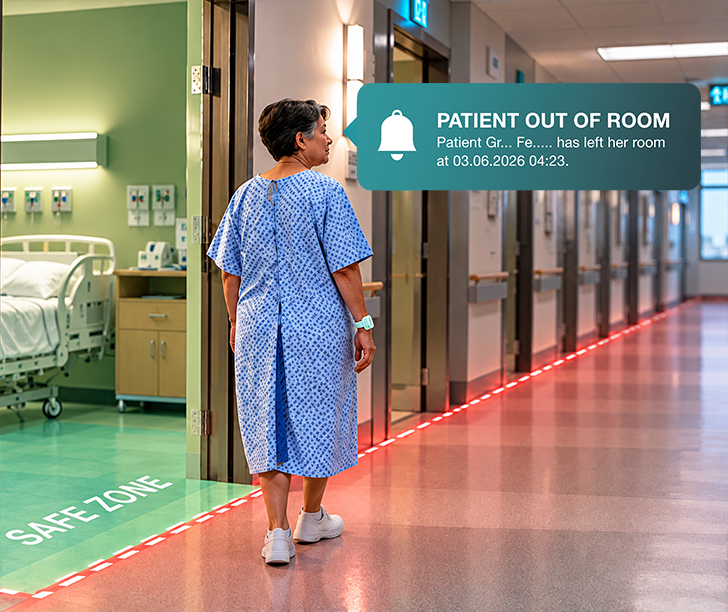
A patient wandering management system is a technology solution designed to detect and alert staff when a patient at risk of wandering moves beyond a designated safe zone. When powered by RTLS, it uses wearable patient tags and a network of zone sensors to trigger an automatic alert the moment a patient crosses a boundary — whether that boundary is a room door, a ward exit, or a building perimeter.
The alert is immediate, precise, and actionable. Staff receive the patient’s exact location in real time, allowing them to respond before the patient reaches an unsafe area. This is fundamentally different from traditional wander guard systems, which typically rely on door alarms that only fire after a patient has already attempted to exit.
ow Does RTLS Patient Wandering Management Work?
RTLS patient wandering management works through three integrated components working together continuously.
The first is the patient wearable tag — a lightweight, comfortable device worn by the patient throughout their stay. The tag communicates continuously with the facility’s sensor network, transmitting the patient’s location in real time without requiring any action from the patient or clinical staff.
The second is zone configuration — clinical and security teams define safe zones and restricted zones within the hospital’s digital floor plan. Each patient can be assigned individual zone rules based on their risk profile, meaning a high-risk patient can have tighter boundaries than a patient with full mobility and orientation.
The third is automated alerting — the moment a patient’s tag enters a restricted zone or approaches a defined boundary, an alert fires instantly to the relevant staff members, including the patient’s identity, current location, and the zone boundary crossed.
What Is the Difference Between Patient Wandering Management and Infant Safety Systems?
Patient wandering management and infant safety systems share the same underlying RTLS technology but serve different patient populations and address different risks.
Patient wandering management focuses on adult patients — particularly those with dementia, cognitive impairment, or conditions that affect orientation — who may unknowingly move into unsafe areas.
Infant safety systems focus on newborns in maternity and NICU settings, where the primary risk is unauthorized removal or transfer. These systems use wearable infant tags that trigger an immediate alert and, in some configurations, automatic door lock activation if an infant is moved toward an exit without authorization. Both systems run on a single RTLS platform.
What Is the Difference Between a Traditional Nurse Call System and an RTLS-Integrated Nurse Call System?
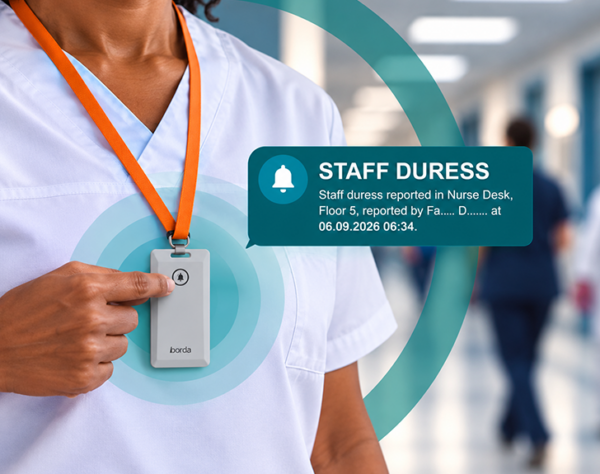
A traditional nurse call system tells staff that a patient needs help and where the call originated. It does not tell staff who is closest, who is available, or whether the call was acknowledged and responded to.
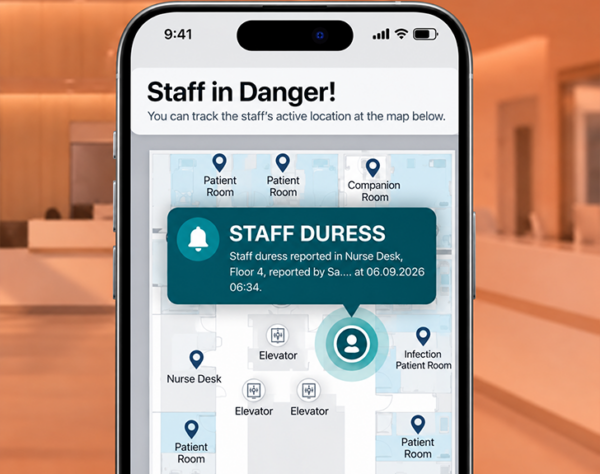
An RTLS-integrated nurse call system adds real-time intelligence to every call. When a patient activates a call, the system identifies the nearest available staff member using RTLS location data and routes the alert directly to them. It tracks whether the call was acknowledged, how long it took to reach the patient, and whether the response met defined service standards.
How Does RTLS Improve Nurse Call Response Times?
RTLS improves nurse call response times by eliminating the inefficiency of centralized dispatch. In a traditional system, a call goes to a nursing station, a staff member decides who should respond, and that person is notified — often through a secondary communication step. Each handoff adds time.
With RTLS, the system identifies the closest available staff member automatically and notifies them directly the moment a call is activated. There are no intermediate steps, no central dispatch decisions, and no delays caused by staff being unaware of who is nearest. The result is a faster, more consistent response across every shift.
What Is Patient Safety Monitoring and How Is It Different from Patient Tracking?
Patient tracking answers the question: where is this patient right now?
Patient safety monitoring answers the broader question: is this patient safe right now — and will I know instantly if that changes?
Patient safety monitoring encompasses location tracking but extends further, incorporating zone boundary alerts, fall risk notifications, unauthorized movement detection, nurse call integration, and condition-based rules that trigger alerts based on a patient’s individual risk profile. RTLS-based patient safety monitoring allows hospitals to configure individualized safety parameters for each patient and receive automated alerts the moment any parameter is breached.
How Does a Hospital RTLS Platform Connect Patient Safety, Wandering Management, and Nurse Call?
A hospital RTLS platform connects patient safety, wandering management, and nurse call by running all three on the same underlying location infrastructure. Rather than operating as separate siloed systems, an integrated RTLS platform uses a single network of sensors and a unified software dashboard to manage all patient safety functions simultaneously.
A single patient tag provides location data for wandering management, feeds into nurse call routing logic, and supports safety monitoring alerts — all without requiring separate systems or manual coordination. For clinical and security leadership, it means a single operational view of patient safety across the entire facility, in real time.
What Types of Patients Benefit Most from RTLS Patient Safety Systems?
RTLS patient safety systems deliver the greatest impact for patients with dementia or cognitive impairment who are at risk of wandering, post-operative patients who require close monitoring during recovery, fall-risk patients who need immediate response if they attempt to leave their bed or room unsupported, psychiatric patients where elopement is a safety and liability concern, and newborns in maternity and NICU settings where infant safety is paramount.
Beyond these high-risk populations, RTLS patient safety benefits the broader patient population by ensuring nurse calls are answered faster, staff are always aware of patient locations during emergencies, and the facility maintains a documented record of patient safety monitoring for accreditation and compliance.
How Does Patient Safety RTLS Support Hospital Compliance and Accreditation?
Patient safety RTLS supports hospital compliance and accreditation by providing a complete, auditable record of patient location, alert activations, staff response times, and incident resolutions. For Joint Commission surveys, CMS inspections, and state-level regulatory reviews, this documentation demonstrates that the hospital has systematic, technology-supported processes for patient safety monitoring.
In the event of a patient safety incident, RTLS provides a timestamped location trail that allows clinical and risk management teams to reconstruct exactly what happened, when it happened, and how staff responded — a level of documentation increasingly expected by accreditation bodies.
Ready to Protect Every Patient, Everywhere in Your Facility?
A connected RTLS platform brings patient tracking, wandering management, nurse call, and infant safety together into a single, always-on safety ecosystem. If your hospital is ready to move from reactive response to proactive patient protection, we are ready to show you how.
👉 Request a demo now: https://bordatech.com/demo-request
Early Access Before Official LaunchLimited Spots
The 90‑Day No Cost Pilot Program.
Hospital RTLS Asset Tracking with Your Access Points.
Zero new installations. No commitment. Ready within a week.
*By sending your information, you agree to our use of your data in accordance with our Privacy Policy.
05 October, 2026