No credit card required
 Thank you for your request. We will contact you shortly.


The Complete Guide to Healthcare Asset Management with RTLS
The Complete Guide to Healthcare Asset Management with RTLS
Hospital Asset Tracking, Asset Utilization & Asset Maintenance Management Software
The Complete Guide to Healthcare Asset Management with RTLS
Hospital Asset Tracking, Asset Utilization & Asset Maintenance Management Software
In today’s healthcare environments, asset availability is directly connected to patient care quality, staff efficiency, and overall operational performance. Hospitals manage thousands of assets across clinical and technical departments, and even short disruptions in asset availability can lead to delayed procedures, inefficient workflows, and compromised patient experiences.
This is why modern healthcare asset management increasingly focuses on the integration of hospital asset tracking, asset utilization, and asset maintenance management software (healthcare CMMS). Together, these capabilities enable healthcare organizations to maintain real-time operational awareness, reduce downtime, and ensure that assets are always available to support patient care.
What Is Healthcare Asset Management?
Healthcare asset management with RTLS refers to the coordinated management of assets across tracking, utilization, and asset maintenance processes within hospital environments.
Rather than managing these capabilities through disconnected systems, healthcare organizations increasingly rely on healthcare CMMS and hospital asset tracking systems working together as part of a unified healthcare asset management system.
Through this connected approach, hospitals gain continuous visibility into where assets are located, how they are used, and whether they are available, idle, under maintenance, or out of service. This real-time insight allows healthcare teams to respond faster, allocate assets more effectively, and support uninterrupted clinical operations.
Why Hospital Asset Tracking & Asset Utilization Are No Longer Optional
In many healthcare facilities, assets may remain unavailable not because they are actively in use or under maintenance, but simply because they cannot be located. These visibility gaps create operational inefficiencies that quickly translate into clinical challenges.
- When a critical healthcare asset cannot be found:
- Clinical procedures may be delayed or rescheduled
- Staff spend valuable time searching instead of delivering care
- Backup assets may not be immediately accessible
- Patient flow and safety may be impacted
This is why healthcare asset tracking has become a foundational requirement for modern healthcare operations.
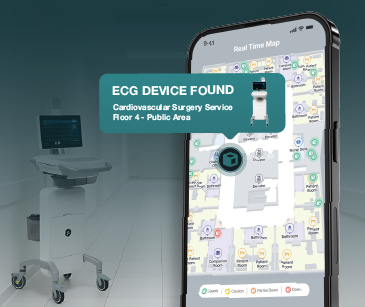
Hospital asset tracking systems provide real-time visibility into asset location across departments, enabling healthcare organizations to instantly locate assets that would otherwise remain unavailable. However, knowing where an asset is located is only part of the equation.
Healthcare asset utilization adds the missing layer of operational context by showing how assets are actually used across the hospital. By combining hospital asset tracking with asset utilization insights, healthcare organizations can monitor how frequently assets are used, how long they remain idle, and whether assets are optimally allocated across clinical units.
Assets that appear “unavailable” in practice are often simply idle in the wrong location. Through integrated healthcare asset tracking and utilization, hospitals can instantly locate missing assets, prevent prolonged downtime, and ensure that critical assets are available where patient care depends on them most.
This integrated visibility allows healthcare organizations to reduce unnecessary asset purchases or rentals while improving operational efficiency and patient experience.
- Hospitals implementing RTLS have reported significant improvements, including:
- 94% Decrease in Search Times: Staff can locate critical assets quickly, improving response times.
- 90% Reduction in Asset Misplacement: Precise location tracking eliminates unnecessary replacements.
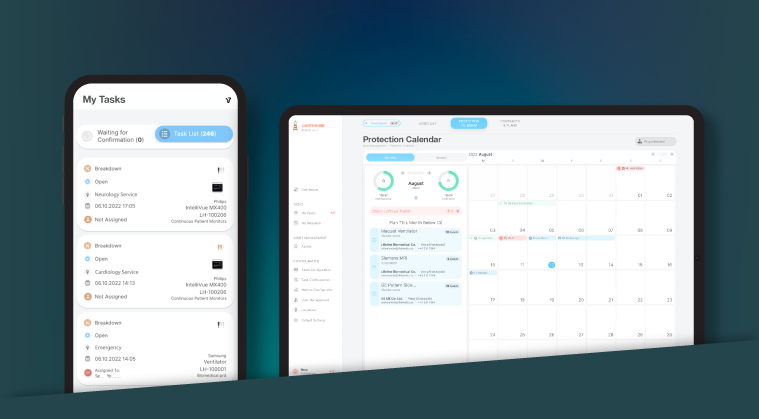
Healthcare CMMS (Asset Maintenance Management Software) powered by hospital RTLS
Healthcare CMMS plays a central role in ensuring that healthcare assets remain safe, compliant, and operational throughout their lifecycle. As asset maintenance management software (healthcare CMMS) enables hospitals to manage preventive maintenance, calibration, and breakdown processes in a structured and auditable way.
A modern healthcare CMMS provides centralized visibility into maintenance, calibration and breakdown activities, allowing healthcare organizations to schedule, track, and document tasks without relying on manual processes or paper-based workflows. This ensures that tasks are completed on time and that assets are returned to service as quickly as possible.
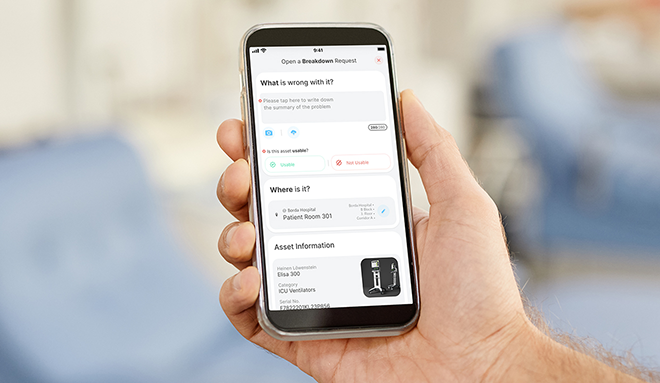
When healthcare CMMS is connected with hospital asset tracking, maintenance workflows become significantly more efficient. Maintenance requests include real-time asset location and status, enabling technicians to respond faster without manual coordination or asset searches.
Preventive maintenance and calibration activities are aligned with real-time asset availability, reducing unplanned downtime and extending asset lifespan. In breakdown scenarios, healthcare CMMS supports rapid response by allowing hospital staff to submit digital requests that are automatically routed to the appropriate biomedical technician along with accurate real-tme asset location information.
AI-assisted healthcare CMMS capabilities further support technicians by providing asset-specific recommendations and troubleshooting guidance, helping resolve issues efficiently while minimizing service interruptions.
Through this integrated approach, healthcare organizations improve asset availability, reduce operational risk, and ensure that assets consistently support patient care and regulatory compliance.
Asset management via hospital RTLS is about maintaining continuous, real-time awareness of RTLS asset tracking, asset utilization, and asset maintenance status across the hospital.
By focusing on hospital RTLS asset tracking, healthcare asset utilization, and healthcare CMMS, healthcare organizations gain the operational clarity required to reduce delays, improve staff efficiency, and ensure that assets are always available to support high-quality patient care.
Ready to take control of your hospital’s asset management? Discover how RTLS solutions can help you save costs, improve efficiency, and deliver superior patient care. Contact us today for a free demo.
January 28, 2026







 Thank you for your request. We will contact you shortly.