No credit card required
 Thank you for your request. We will contact you shortly.


Key Criteria to Choose the Best RTLS Vendors for Healthcare
Key Criteria to Choose the Best RTLS Vendors for Healthcare
Real-Time Location Systems (RTLS) have become a foundational layer in modern hospital operations. In environments where time, coordination, and visibility directly impact patient outcomes, having real-time access to the location of assets, patients, and staff is no longer optional. Healthcare organizations are increasingly adopting hospital RTLS solutions not only to improve operational efficiency, but also to strengthen patient safety, staff safety, and overall quality of care.
Choosing the best RTLS vendor for hospitals, however, is not simply a matter of comparing features. It requires a deeper understanding of how the technology will function within the daily realities of a healthcare environment and how well it can adapt to evolving needs over time.
What is RTLS in hospitals? What Healthcare RTLS Really Enable?
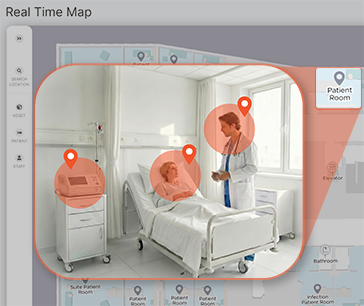
RTLS (Real-Time Location Systems) in healthcare is a technology used to track the real-time location of patients, staff, and medical assets within a hospital using technologies such as BLE, AoA, and UWB. It helps improve patient safety, staff safety, operational efficiency, and staff response times.
RTLS does far more than simply track the location of assets and people. It creates a continuous layer of visibility across the hospital, allowing clinical and operational teams to respond faster, coordinate better, and eliminate inefficiencies that often go unnoticed in complex environments.
With real-time visibility, hospitals can significantly reduce the time spent searching for assets, improve response times in urgent situations, and better manage patient movement across departments. Over time, these improvements contribute directly to both operational performance and patient safety, which is why healthcare RTLS is increasingly considered a strategic investment rather than a supporting tool.
Location Accuracy and RTLS Technology: The Core.
Accuracy remains one of the most defining factors when selecting an RTLS system. Different hospital use cases require different levels of precision, and a one-size-fits-all approach rarely works in practice. While some workflows operate effectively with room-level visibility, others—particularly those related to patient safety and staff duress—may require sub-meter accuracy and highly reliable real-time location data.
This is where the underlying technology becomes critical. Bluetooth Low Energy (BLE) enables scalable and cost-effective deployments, while Angle of Arrival (AoA) significantly enhances location accuracy without requiring dense infrastructure. Ultra-Wideband (UWB) provides very high precision for use cases that demand the highest level of accuracy. Hospitals need hybrid RTLS approaches that combine BLE, AoA, and UWB technologies, allowing them to align accuracy levels with specific operational needs while maintaining both scalability and precision within a single system.
Choose the Best RTLS Solution: Manage Everything Within One Platform.
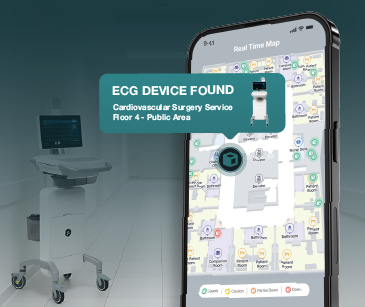
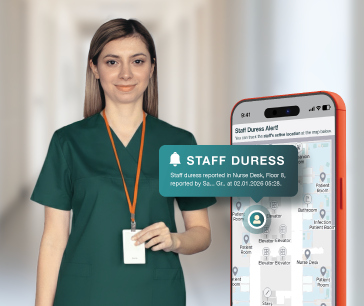
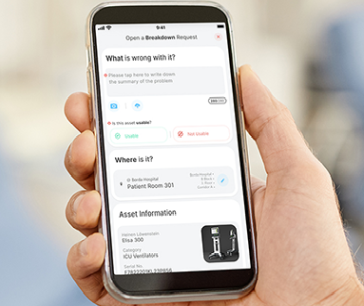
Staff Duress & Safety, Patient Safety, Patient Wandering Management, Patient Tracking, Asset Tracking, Asset Management, CMMS Softwarew, Patient Flow.
Hospitals rarely implement RTLS for a single use case. Instead, they require a system that can support a wide range of operational needs within a unified platform. This includes hospital asset management, asset tracking, asset utilization, staff duress system and staff safety, patient safety, patient wandering prevention, nurse call integration, patient flow optimization, temperature monitoring, and more.
Managing all these capabilities within one centralized system allows hospitals to standardize processes, reduce system fragmentation, and improve overall efficiency. Rather than deploying separate solutions for each need, a unified hospital RTLS system enables a more cohesive and scalable approach to hospital operations.
RTLS Tag Battery Life and Its Operational Impact
RTLS Tag Battery life is often underestimated during the decision-making process, yet it has a direct impact on operational workload and long-term efficiency. RTLS tags with extended battery life—reaching up to five years—significantly reduce the need for replacements and ongoing maintenance.
In large hospital environments where thousands of assets and wearable devices are in use, this translates into fewer interruptions, lower maintenance effort, and a more sustainable operational model. Over time, longer battery life becomes not just a technical advantage, but a critical factor in reducing total cost of ownership.
Infrastructure Compatibility and Deployment Flexibility
The ability of a hospital RTLS system to integrate with existing infrastructure is often a deciding factor in successful deployments. Some solutions require the installation of additional hardware layers, others are designed to work seamlessly with existing WiFi access points, enabling faster implementation and minimizing disruption.
For hospitals, this flexibility makes a significant difference. Systems that align with existing infrastructure allow organizations to move from planning to execution more quickly while making it easier to scale across departments or facilities without major additional investment.
Integration Capabilities and System Connectivity
Healthcare RTLS delivers its full value when it operates as part of a connected ecosystem rather than as a standalone system. Integration with hospital information systems (HIS), electronic medical records (EMR), and nurse call systems enables location data to flow across departments and support broader operational processes.
When RTLS is fully integrated, it becomes possible not only to track assets and people, but also to automate workflows, improve coordination between teams, and support real-time decision-making. This level of connectivity is essential for hospitals looking to maximize the impact of their digital transformation initiatives.
Pilot Testing
Before full-scale deployment, pilot testing plays a critical role in validating the performance of an RTLS system. A well-structured pilot allows hospitals to evaluate accuracy, system responsiveness, integration capabilities, and overall usability within a real clinical environment. It also helps identify potential challenges early, ensuring that the system can be optimized before scaling across the organization.
Scalability
Hospitals require RTLS systems that can grow alongside their operations. Scalability is not only about expanding coverage across departments but also about supporting additional use cases over time. A scalable RTLS platform enables hospitals to start with a focused implementation and expand into broader operational workflows without requiring a complete system redesign.
Support
Ongoing support is a critical component of long-term RTLS success. Hospitals need reliable technical support, system monitoring, and continuous updates and well-defined SLA commitments to ensure consistent performance. Strong post-deployment support allows organizations to maintain stability, quickly resolve issues, and continuously improve system performance.
Security
Given the sensitive nature of healthcare data, security is a fundamental requirement for any RTLS system. Data protection, secure integrations, and compliance with healthcare regulations must be built into the platform. A secure RTLS system ensures that location data is protected while still being accessible to authorized personnel for operational use.
What Hospitals Should Prioritize When Choosing the Best RTLS Company
Selecting the right RTLS vendor ultimately comes down to how well the system aligns with real operational requirements. Accuracy, technology, flexibility, battery life, integration capabilities, and the ability to support multiple use cases all play a critical role in long-term success.
Hospitals that focus on these factors—rather than only comparing feature lists—are more likely to implement solutions that deliver measurable value over time. The goal is not simply to adopt new technology, but to create a system that can evolve alongside the organization.
How to Identify the Right Hospital RTLS System
The best RTLS vendor for hospitals is not defined by a single feature, but by its ability to deliver high accuracy, flexible deployment, long battery life, and seamless integration within healthcare environments. Vendors that offer hybrid technologies such as BLE, AoA, and UWB, along with multi-use case platforms, are better positioned to meet complex hospital needs.
Conclusion
Choosing the best RTLS vendor for hospitals is a strategic decision that extends beyond technology selection. The right system should enhance visibility, improve patient safety, staff safety, and support more efficient workflows across the entire organization.
Healthcare RTLS solutions that combine precision, adaptability, and strong integration capabilities enable hospitals to build a more responsive and future-ready operational model. As the demands on healthcare systems continue to grow, RTLS will play an increasingly central role in shaping how hospitals operate.
Ready to Explore Healthcare RTLS System?
If you are evaluating hospital RTLS solutions and want to see how these capabilities can be applied in real-world scenarios, you can explore how a unified platform supports asset tracking, staff safety, patient monitoring, and workflow optimization within a single system.
👉 Book a demo to discover how healthcare RTLS can transform hospital operations.
April 15, 2026







 Thank you for your request. We will contact you shortly.